
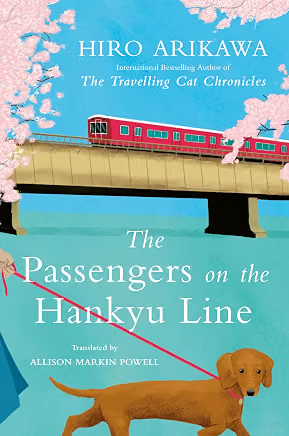
It was either a reader here, or someone in the book chat group at the library who mentioned Hiro Arikawa’s novel, The Passengers on the Hankyu Line. Knowing that I’ve been reading Korean and Japanese translations, it might have been someone here. This one, “an enduring Japanese classic”, is translated by Allison Markin Powell. The book was published in Japan twenty years ago.
The Hankyu Line train travels through a mountainous area of Japan. “All manner of people from every walk of life – solo passengers, friends, couples, families, work colleagues – traverse the concourse at a brisk pace. But as they cross paths, the contents of each traveler’s heart are a mystery known only to themselves.” Arikawa’s goal is to introduce us to a few of those passengers, and their hearts.
There is a cast of characters at the beginning. There are office workers, college and high school students, a housewife, a grandmother and granddaughter. In the first half of the book, readers meet them, and learn of their problems or worries. Six months later, we meet them again on the train, and we learn the resolution to their earlier storyline. Two college students had seen each other at the central library, and he realized they had similar reading taste, and finally spoke on the train. One young woman suffered from her abusive boyfriend who made a scene on the train. It was the grandmother who encouraged her to leave him. Shoko, my favorite character, dated a co-worker who cheated on her with another another co-worker. Her revenge was perfect, and she took the train wearing a white bridal dress. Some of the characters interacted with each other, and those encounters made the story more interesitng.
I had a hard time remembering some of the college and high school students, who was who, and who was dating. However, I enjoyed the story of Tokie, the grandmother, who was a strong woman who spoke up for others. Shoko, though was my favorite, the one who attended the wedding of her boyfriend of five years, and left them feeling cursed.Tokie, the grandmother, strikes up a conversation with her, and changes her whole life. In return, Shoko pays it forward with a younger woman.
The entire second half felt like an epilogue, and I appreciated it. I enjoyed the discovery of what happened to the characters in the six months following the first encounters on the Hankyu Line. As I said, the student relationships were a little too similar, but that may have been the names, too. However, The Passengers on the Hankyu Line were interesting characters in this Japanese story.
The Passengers on the Hankyu Line by Hiro Arikawa. Translated by Allison Markin Powell. Berkley, 2008/2025. 256p.
FTC Full Disclosure – Library book


Would to read that one. It reminds me of a short but unforgettable train ride through part of Japan that I had back in 1992. The scenery was breathtaking,